Posts

Sayonara, Mr. Gandhi...

Image
Mohandas Karamchand Gandhi is a name and persona not fully understood by the West. Today, we often refer to him as the 'thin man in the loin cloth, who helped bring his country to independence', but we know little to nothing about his beliefs, his struggles, and his ability to transcend cultural and religious barriers. Here in the west, we carry no comparable measure to the 'man in the loin cloth', but we often briefly reference him when we discuss civil disobedience or nonviolence. Sure, we had Martin Luther King Jr. in the 1960s and Henry David Thoreau in the 1840s, but whom do we admire today? Where is the man or woman who speaks truth against the majority? Can he or she be found in the political scene today? I argue no. A man like Gandhi would be killed, labeled a heathen or unconscionable liberal with little or nothing to offer today's political scene. In fact, during his second civil disobedience campaign of the 1930s, Winston Churchill spoke of Gandhi in the...
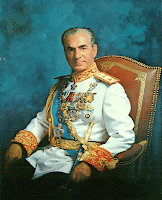
The Days of Iran's Last Shah, Mohammed Reza Pahlavi

Image
"Shah is a kind of magic word with the Persian people. " Mohammed Reza Pahlavi, Shah of Iran 1941-1979 The Iranian past, similar to the Russian past, has been hidden for decades. Little did Stalin know in the 1930s that forcing a policy of kolkhozy or collectivization of peasants' lands, would create a radical resistance movement among the kulaks and peasants against collectivization. The Shah of Iran was not Stalin, in fact, comparably far from him. But his White Revolution as he phrased it, beginning in 1963 and ending in 1977, mobilized semi-industrial peasants known as the bazaaris in an alliance with the religious clerics against rapid modernization and the Shah. These modernization policies introduced a series of land reforms and Westernizing trends that would elevate Iran onto an industrialist and capitalist platform alongside the major Western powers of the day. The problem with the Shah's policies were not that he sought to ring in capitalism to the Iranian ...

Belgili Tanımlık Türk Dünya (The Turkish World)

Image
Oriental historians are quick to reverance the art and culture of the 18th-19th century Turkish world, but often times against the measure of European standards. I am not quick to disfigure Oriental historians as the purveyors of a skewed understanding of the East, but I will say that when Orientalists measure the Eastern standard against the Western one, they are bound to come to muddled conclusions. Turkish identity has been molded by centuries of insularity, apathy for Europe, and complete rapture of all things Ottoman. After all, they were the coffee drinkers, the casbah owners, the Sultans of Istanbul, the harem seekers, the viziers, the pashas, the whirling dervishes, etc. What could the east possibly learn from the west? The answer could be found in a scientific revolution that only the secular west could provoke. Although science was always part and parcel to Islamic understanding (Al-Farabi, Al-Ghazzali, Al-Razi, the list goes on), it remained a static subject. Muslims did not...

The Hands That Built America

Image
photo taken by Lewis Hine "Rising above tension below Learn from the in-between; Blinded by trust, asleep to the truth, Awakened by disbelief; Somewhere I found strength in my soul, Still you refuse to see; Are you sure I'm not all right? 'Cause lately I've been feeling fine! Every lifeline leads its own way to the heavens, But I have seen you run in circles, unforgiven; Is there anything in this world that can make you stop? Oh, you're a machine!" -Josh Groban, "Machine" The farm-to-factory movement of the early 20th century paved the way for American economic hegemony of the world. Let's face it, the Protestant work ethic and the 'money doesn't grow on trees' mentality, established the economic boom of the 1920s, 50s, and 80s. But just how did we manage to pull it off after all those years? And better yet, how can we get it back in the years to come? Perhaps we cannot. With industrialization comes great responsibility, and America t...

Luther's Reformation and Achievements

Image
If religion set the tone for the 15th century, extravagance and growing secularism set the tone for the 16th, giving rise to a Renaissance unparalleled in world history. The Italian Renaissance, founded on humanist scholasticism, brought forth a mental transformation, giving power to artistry, math, geometry, science, and reason. Da Vinci's Vitruvian Man and Michaelangelo's Pieta were products of this artistic enlightenment, but it was the British and German philosophers that would formulate the most mental change among Europe's literary elites. Men like John Wycliffe and Johan Hus would question Catholic dogma in the 15th century, leading one particular man, Martin Luther, to carry on where these men left off. Luther's reformation was a byproduct of growing hedonism in the Catholic Church. Ever since the Investiture Controversy of 1075, the Pope officially broke away from secular control and declared full power over spiritual and temporal matters, thus granting himself...

The Golden Age of Islam [750-1258] and the Resurgence of Intellect

Image
In the period between 786-809, during the reign of Haroun al-Rashid, a Persian nobleman wrote a letter to his father describing Baghdad as the 'City of Wonders'. He wrote, "It is difficult for me, with this pen which is of limited substance, to describe the glorious qualities of the city which are but a small part of the honor it achieves, as such that it prides itself in the splendor of power..." So much was told, back then, of this magnificent city of gold and wealth, that philosophers and scholars ventured to Baghdad to be taught the Greek and Roman classics. They named themselves the 'falsafa' or philosophers of the Arabian and Islamic world and spread their wealth of knowledge on architecture, politics, astronomy, math, and medicine to areas of Spain, Sicily, Egypt, Turkey, Syria, Persia, and the Hindu Kush. Without the falsafa, a Renaissance in the West would never have happened. In the 8th century, Rome looked like an agricultural playing field, open to...

American Racism Unveiled

Image
The period of Reconstruction beginning 1865 to 1877 is crucial to understanding America's present-day racial tensions. Although these tensions have subsided dramatically since the mid-1990s, American youth today and I would argue the older generations, have failed to acknowledge and understand the dichotomy of race and racial constructs since social darwinism raised its ugly head in the 1860s. The most prevalent existence of American racism persists in what Whites deemed 'utopia' back in the 1920s. This 'utopia' would emerge out of the growing pollution, immigrant infestation, and overcrowdedness of northern cities. It was this 'utopia' that would define the American dream and would enable Whites of middle and upper-class stature to create their own communities outside of the muck-ridden cities. I am talking about Suburbia, that which would not exist without the endless stretches of highway and commercial developments generating on every corner. But at what ...